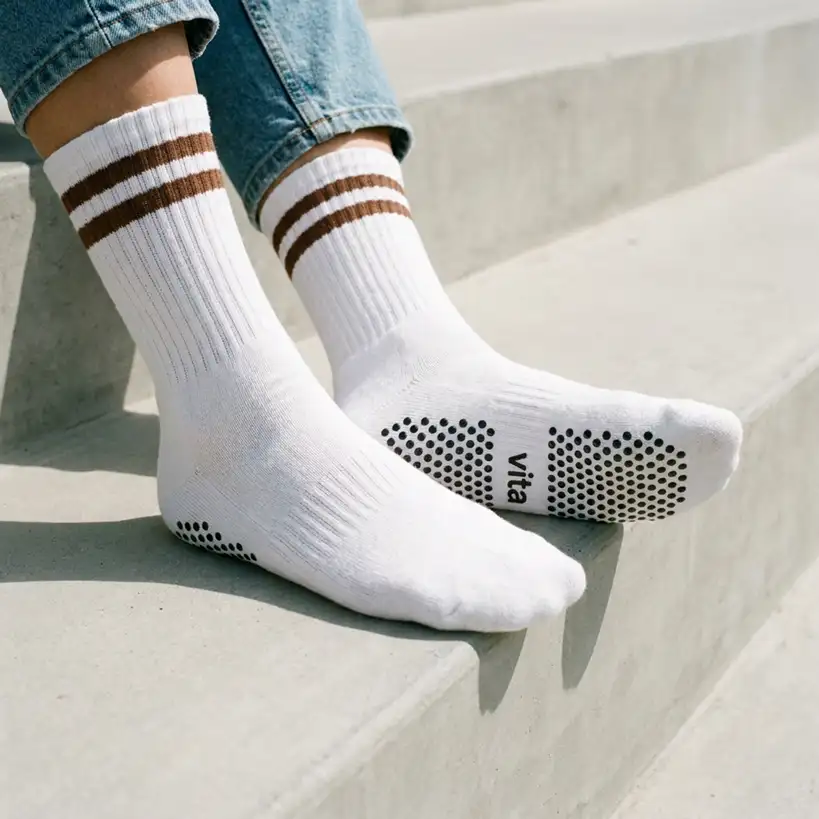
Low MOQ Custom Socks: How Many Pairs Should a New Brand Order?
A practical guide for startups and small brands comparing 50, 100, 300 and 500-pair orders, including the real impact of designs, colors, materials, grip patterns and packaging on MOQ.
Most new sock brands should begin with one or two strong designs and the smallest commercially practical order. If the production method allows it, roughly 50–150 pairs per design can be a useful testing range. Orders of 300–500 pairs generally make more sense after a product, color or customer group has shown real demand.
50, 100, 300 or 500 Pairs?
How Many Pairs of Custom Socks Should You Order First?
The first production run should answer questions about the market, not simply fill a warehouse. You need enough product to photograph, sell, sample and collect meaningful customer feedback, but not so much that one weak design ties up your working capital.
| Quantity | Best For | Main Advantage | Main Risk |
|---|---|---|---|
| 50 pairs | Product testing | Low inventory exposure | Higher cost per pair |
| 100–150 pairs | Small brand launch | Balance of testing and usable stock | Limited room for many variants |
| 300 pairs | Validated product | Better production economics | More capital in inventory |
| 500+ pairs | Growing brand | Improved unit economics | Higher stock commitment |
When Does a 50-Pair Custom Sock Order Make Sense?
A very small production run can make sense for a new streetwear label, an early grip sock concept, a limited release or a brand testing a new customer group.
That first batch can help you learn:
- which colors customers actually choose;
- which sizes move fastest;
- whether the cuff maintains its elasticity;
- how the product feels after extended wear;
- whether the packaging suits the selling price;
- and whether customers would reorder.
Is 100–150 Pairs Better for a Small Brand Launch?
This range can provide stock for photography, influencer samples, customer orders, advertising tests and small wholesale enquiries without immediately creating a large inventory position.
Higher-Risk Launch
5 designs × 100 pairs = 500 pairs
More variety looks attractive, but demand is spread across more SKUs before you know what customers actually want.
Controlled Launch
2 designs × 75 pairs = 150 pairs
Test two strong concepts first, then put the next production budget behind the better seller.
When Should You Move to 300–500 Pairs?
A larger production run becomes more reasonable when:
- the previous batch sold successfully;
- customers are waiting for a restock;
- you have repeat wholesale buyers;
- your online store has consistent sales history;
- a retailer has confirmed an order;
- or you know which color and size combinations perform best.
Unsold low-cost inventory is still expensive inventory.
What Does MOQ Actually Mean in Custom Sock Manufacturing?
Suppose a supplier advertises a 100-pair MOQ and you want four different product variations. That does not necessarily mean you can order 25 pairs of each.
The factory may instead require 100 pairs for each individual design or colorway.
Also confirm:
- whether sizes can be mixed;
- whether colors can be mixed;
- whether multiple designs can share one production minimum;
- and whether packaging has a separate MOQ.
Why Can Too Many Colors Increase Inventory Risk?
For example:
3 designs × 4 colors × 3 sizes = 36 SKU combinations.
You may sell out of Medium / Black while still holding Large / Green inventory months later. More combinations can also require additional yarn preparation, color matching, labeling and packaging.
For most first collections, one or two strong colorways are easier to test than six average ones.
Does the Number of Sock Designs Affect MOQ?
Each design can require its own:
- knitting program;
- yarn combination;
- logo setup;
- embroidery program;
- grip layout;
- sample approval;
- and quality inspection.
For a startup with a limited budget, reducing design complexity can sometimes save more money than negotiating a few cents off the unit price.
Do Knitted, Embroidered and Printed Socks Have Different MOQs?
Knitted / Jacquard
The artwork is built into the sock with yarn. This is widely used for logos, patterns, sports socks and private label collections.
Embroidery
Suitable for smaller raised logos and premium detailing, but requires an embroidery program and additional production work.
Printed Socks
Useful for gradients, photographs and highly detailed artwork that would be difficult to reproduce through knitting.
Best Method?
Choose based on design appearance, durability, material, order quantity and target selling price—not MOQ alone.
Why Can Custom Grip Socks Have a Different MOQ?
A fully customized grip sock may involve:
- custom silicone patterns;
- logo placement under the foot;
- specific grip colors;
- custom grip coverage;
- special sock construction;
- and additional curing and inspection.
Lower Complexity
Existing grip sock structure + custom logo
Usually easier to develop and suitable for brands testing the market.
Higher Complexity
Custom knitting + color + grip pattern + packaging
Requires more development work and may have different production minimums.
Can Custom Packaging Increase the MOQ?
A factory may accept a small sock order while a specialist packaging supplier requires a much larger quantity for custom printed boxes or premium packaging.
For early launches, simpler options are often more practical:
- belly bands;
- header cards;
- stickers;
- standard bags;
- or simple branded inserts.
Does Sock Material Affect MOQ?
This is especially relevant for products such as:
- Merino wool hiking socks;
- Coolmax performance socks;
- ski socks;
- heavy terry sports socks;
- bamboo socks;
- compression socks;
- and technical running socks.
The material should solve a customer problem—warmth, moisture management, cushioning, abrasion resistance, breathability or compression.
Is the Lowest MOQ Supplier Always the Best Choice?
Before bulk production, evaluate:
- Sample accuracy: does production match the approved sample?
- Elastic recovery: does the cuff keep its shape?
- Logo clarity: are small details readable?
- Toe comfort: is the seam comfortable?
- Size consistency: are measurements stable?
- Color consistency: can the shade be reproduced?
- Grip durability: does silicone remain securely bonded?
- Washing performance: does the sock keep its shape?
- Repeatability: can the specification be reproduced later?
What Happens When Your First Batch Sells Out?
Before selecting a factory, ask:
- Is the original knitting program saved?
- Can the same yarn and color be sourced again?
- How quickly can a repeat order be produced?
- Can the same fit and measurements be maintained?
- Can the factory handle 500, 1,000 or more pairs later?
- Can packaging scale with the order?
How Should a New Brand Control Inventory Risk?
It is usually much easier to add another color after a successful launch than to deal with hundreds of slow-moving pairs from the first collection.
Should You Use Pre-Orders Before a Larger Sock Order?
They work best when production timing, shipping estimates, delays and cancellation policies are clearly communicated.
For a brand with little or no existing audience, a controlled small batch may provide more useful real-world demand data.
How Should You Calculate the Real Cost of a Small Sock Order?
The real cost can include:
- sample development;
- production;
- special yarn;
- embroidery;
- grip application;
- labels;
- packaging;
- cartons;
- international freight;
- duties;
- and final delivery.
What Should You Send a Sock Manufacturer for an Accurate Quote?
Send as much of the following as possible:
- sock type;
- reference images;
- logo or artwork;
- preferred material;
- sock height;
- target quantity;
- number of designs;
- number of colors;
- size range;
- branding method;
- grip requirements;
- packaging requirements;
- delivery country;
- and required delivery date.
If you do not yet know every specification, an experienced sock manufacturer should be able to convert your reference image, sketch or concept into a manufacturable product.
How HEHE Apparel Works With Small Sock Brands
For startup projects, we first review the product type, material, colors, sizes, branding, packaging, target market and expected order volume before recommending a production route.
Depending on the product, we can support flexible Low MOQ and selected No MOQ options so brands can test products before committing to larger inventory.
Low MOQ or Lowest Unit Price: Which Matters More?
Supplier A
500 pairs
Lower unit price, but substantially more money committed to inventory.
Supplier B
100 pairs
Higher unit price, but less inventory exposure while the product is still being tested.
The better comparison is:
Product cost + packaging + freight + duties + cash tied up + risk of unsold stock.
What Is the Best First-Order Strategy for a New Sock Brand?
- Choose one customer group. Decide whether you are designing for streetwear, running, hiking, Pilates, football, gifting or everyday wear.
- Develop one or two strong products. Avoid creating a full catalog before you have customer feedback.
- Approve a physical sample. Check fit, stretch, material, logo appearance, cushioning, grip and washing performance.
- Place a controlled first order. Produce enough stock to test the product properly without creating excessive inventory.
- Measure actual sales. Track colors, sizes, reviews, returns, sell-through time and repeat purchases.
- Scale the winner. Increase production on products that customers have already validated.
Final Recommendation
Start with one or two strong designs, keep the initial color and size structure manageable, approve a physical sample and pay close attention to what customers actually buy.
Once a product has proven demand, larger production runs can improve unit economics with much less inventory risk.
Frequently Asked Questions About Low MOQ Custom Socks
What is a good MOQ for a new sock brand?
For many startup projects, 50–150 pairs per design can be a useful testing range when the manufacturing method supports it. More complex socks and specialty materials may require larger quantities.
Can I order only 50 pairs of custom socks?
Yes, some manufacturing methods can support quantities around this level. Whether 50 pairs is practical depends on the construction, material, logo method, colors, sizes and packaging.
Can I split 100 pairs between several colors?
Sometimes. Some factories allow colors or sizes to be mixed, while others calculate MOQ separately for each design or colorway.
Does adding more colors increase MOQ?
It can. More colorways can create additional production setups and more SKU combinations, increasing both manufacturing complexity and inventory risk.
Why do custom grip socks sometimes have a different MOQ?
Grip socks involve an additional silicone application process. Custom sole patterns, colors, logos and fully customized sock construction can increase production complexity.
Does private label packaging have its own MOQ?
Yes. The packaging supplier may have a different production minimum from the sock manufacturer.
Is the lowest MOQ manufacturer always the best choice?
No. MOQ should be evaluated alongside sample quality, fit, elasticity, consistency, communication, lead time, quality control and reorder capability.
Can I increase the quantity after testing the market?
Yes. That is one of the main reasons to begin with low-volume production. Once demand is validated, larger runs can improve unit economics with lower inventory risk.
Planning Your First Custom Sock Collection?
Send us your logo, reference image or product idea. HEHE Apparel can help evaluate the construction, customization method and suitable starting quantity before production.